


The Time Between Runners
Fifty-five years apart, two southwestern North Dakota runners are connected by more than a record.
By: Debora Dragseth, Ph.D., Faculty Emerita
Since 1971, Jerry Schwartz’s 10,000-meter school record of 31:35 had stood untouched at Dickinson State University.
On April 19, 2026, Caleb Sarsland brought it down with a 30:37 performance that placed his name among the Blue Hawk greats.

But this story is not only about the day the record fell. It is about the meeting that came afterward. A week after Sarsland broke the record, I brought the two runners together for lunch at a local restaurant. A 55-year-old record had just fallen, and the man who set it was still here to see it happen. That alone felt rare.
At the time, I did not yet know how many parallels would emerge between the two runners or how naturally the conversation would unfold. I simply thought there was something meaningful about placing the former record holder and the new one at the same table and seeing where the story led.
Both wore Blue Hawk blue. Both ordered a hamburger cooked pink with pickles, tomatoes, and lettuce. Both chose French fries as their side. Water for their beverage. When asked about condiments, they answered in unison.
“Ketchup.”
Some stories announce their symbolism loudly. This one arrived with matching lunch orders.
Caleb began the conversation. He told Jerry about coming to Dickinson State as a freshman and seeing the 10K record on the wall at the gym. Back then, the record did not represent a person. It was simply a number to respect. Maybe someday, a number to chase.
Jerry admitted he had seen this coming. After retiring from coaching and teaching, he often volunteered at local track meets, which is how he first watched Caleb compete. Over the years, Jerry had often wondered if the kid from Bowman might someday be the one to break his record.
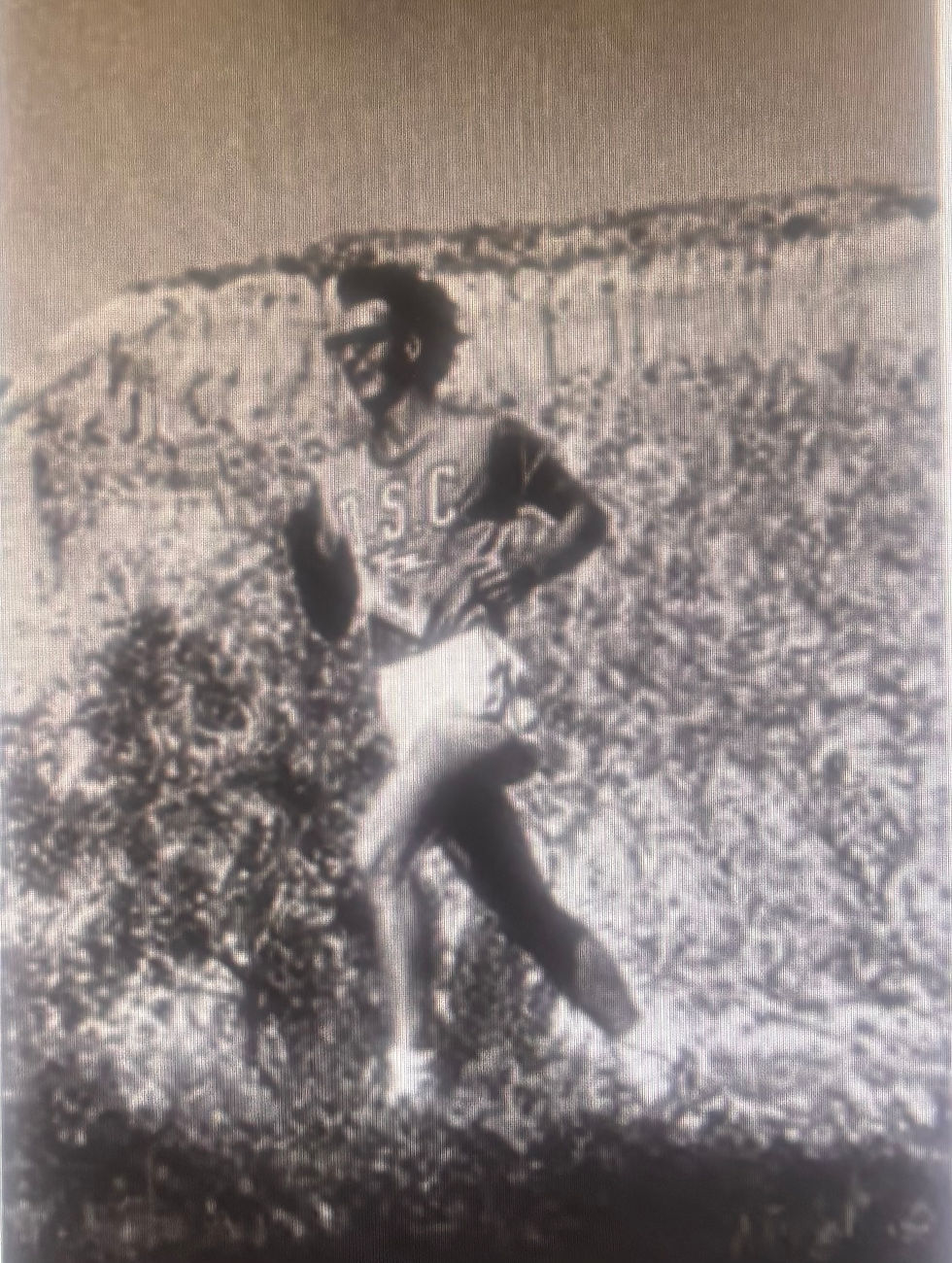
Caleb looked genuinely surprised hearing that the former record holder had been quietly following his races since junior high.
As lunch went on, the similarities kept surfacing.
Both runners came from small Class B towns in southwestern North Dakota. Jerry from New England, population 692, and Caleb from Bowman, population 1,499. They talked about small-town values. About representing southwestern North Dakota. For both men, the connection to place runs deep. Both grew up where gravel roads stretch farther than excuses.
Both are the oldest children in their families, and both spoke warmly about family support and their mothers’ unforgettable cooking. Long before records, races, or coaches, family had been their first team.
Schwartz first considered attending North Dakota State University to become a civil engineer. Instead, he chose Dickinson State and became a math educator. He taught math for 31 years, and spent decades coaching track and cross country. Sarsland arrived at Dickinson State as a math education major before switching to engineering. He plans to finish his engineering degree at UND, then return to Bowman, where he imagines what he calls a perfect life: engineer from 8 to 4, track coach from 4 to 6.
Sarsland’s coaches describe him as humble, disciplined, and deeply competitive—a southwestern North Dakota kid who works hard, gives credit to teammates, and carries a 4.0 GPA.
Schwartz understands that kind of scholar-athlete. He was also an outstanding student who graduated with honors.
More than five decades apart, both runners lived in the same residence hall on the DSU campus. Caleb currently lives in Lowman Walton Hall. When Jerry was a student, the building was known as Pulver Hall.
Jerry had to ask.
“Which floor? I was on fifth.”
Caleb looked stunned.
“Same.”
Even their shoes became part of the conversation. Schwartz ran in $10 Adidas spikes, about $90 in today’s dollars. They were made from kangaroo leather. Yes, kangaroo. Schwartz described them as akin to running barefoot with traction.
Sarsland runs in Nike Dragonfly spikes, shoes engineered for elite distance runners and sold for around $200. He laughed when the price came up. He does not pay retail. He waits for a sale and buys whichever color is cheapest. In rural America, frugality usually outruns vanity.

Schwartz said the 10K requires a certain mental approach. During his record race, he followed another runner for the first three miles, letting that runner unknowingly establish the perfect pace.
Sarsland agreed that the 10K is strategy as much as strength. When he broke the record, he ran consistent 73-second laps. No dramatic surge. No heroic sprint from nowhere. Just lap after lap of discipline.
Both men say the first few kilometers can feel deceptively easy. The “real race” begins around 8K. The final 2K becomes less about fitness and more about pain tolerance, rhythm, and mental discipline.
A perfect 10K requires perfect weather. Cool temperatures and no wind. In North Dakota, cool weather is typically not a problem, but the wind almost always has a say.
For all the differences between their eras, Schwartz and Sarsland agreed on something else: the best training for a distance runner is still hilly terrain and gravel roads. Southwestern North Dakota has never been short on either.
Some athletes speak about their sport like a transaction: effort exchanged for achievement, pain exchanged for results. Schwartz and Sarsland spoke about running as something more. Caleb described it as freedom and peace—a way to use the body God gave him. Jerry agreed.
That may be why the record feels different in their hands.
Caleb did not take something from Jerry. Jerry did not lose something to Caleb. Instead, the record did what the best records eventually do. It connected two people who otherwise might have remained separated by time.
At the end of lunch, they sat side by side in the booth, two legendary Blue Hawks. The old record holder and the new one. The man who set the mark and the man who chased it down, realizing they had far more in common than a 10K record.
Records can be treated like possessions, but Jerry never saw his that way. He treated it more like a baton. It had been his to carry for 55 years. Now it belongs to Caleb.
Someday, another young runner will look at the wall in Dickinson State’s Weinbergen Hall and see Caleb Sarsland’s name.
The number will look permanent.
It is not.
Records are not meant to last forever.
But the best ones wait long enough to matter.
___________
Caleb is currently preparing for the NAIA national meet in Asheville, North Carolina, May 22-25. Asheville will likely offer less wind but far more humidity, so Caleb has been spending time in the sauna at the West River Community Center two blocks from campus, training his body for what the air may feel like when the next big race arrives.


Great story, Dr. Dragseth! Thanks for sharing the fun read.
What a wonderful story. And beautifully written. I remember Jerry. I was a part-time sports writer at the Dickinson Press while attending Dickinson State at that time. And as a high school distance runner, I was especially interested in track and field.